 Add to Chrome
 Add to Firefox
 Add to Edge
Rethinking LoRA for Data Heterogeneous Federated Learning: Subspace and State Alignment
Feb 02, 2026
Low-Rank Adaptation (LoRA) is widely used for federated fine-tuning. Yet under non-IID settings, it can substantially underperform full-parameter fine-tuning. Through with-high-probability robustness analysis, we uncover that this gap can be attributed to two coupled mismatches: (i) update-space mismatch, where clients optimize in a low-rank subspace but aggregation occurs in the full space; and (ii) optimizer-state mismatch, where unsynchronized adaptive states amplify drift across rounds. We propose FedGaLore, which combines client-side GaLore-style gradient-subspace optimization with server-side drift-robust synchronization of projected second-moment states via spectral shared-signal extraction, to address this challenge. Across NLU, vision, and NLG benchmarks, FedGaLore improves robustness and accuracy over state-of-the-art federated LoRA baselines in non-IID settings.

A Federated and Parameter-Efficient Framework for Large Language Model Training in Medicine
Jan 29, 2026Large language models (LLMs) have demonstrated strong performance on medical benchmarks, including question answering and diagnosis. To enable their use in clinical settings, LLMs are typically further adapted through continued pretraining or post-training using clinical data. However, most medical LLMs are trained on data from a single institution, which faces limitations in generalizability and safety in heterogeneous systems. Federated learning (FL) is a promising solution for enabling collaborative model development across healthcare institutions. Yet applying FL to LLMs in medicine remains fundamentally limited. First, conventional FL requires transmitting the full model during each communication round, which becomes impractical for multi-billion-parameter LLMs given the limited computational resources. Second, many FL algorithms implicitly assume data homogeneity, whereas real-world clinical data are highly heterogeneous across patients, diseases, and institutional practices. We introduce the model-agnostic and parameter-efficient federated learning framework for adapting LLMs to medical applications. Fed-MedLoRA transmits only low-rank adapter parameters, reducing communication and computation overhead, while Fed-MedLoRA+ further incorporates adaptive, data-aware aggregation to improve convergence under cross-site heterogeneity. We apply the framework to clinical information extraction (IE), which transforms patient narratives into structured medical entities and relations. Accuracy was assessed across five patient cohorts through comparisons with BERT models, and LLaMA-3 and DeepSeek-R1, GPT-4o models. Evaluation settings included (1) in-domain training and testing, (2) external validation on independent cohorts, and (3) a low-resource new-site adaptation scenario using real-world clinical notes from the Yale New Haven Health System.
FedCal: Achieving Local and Global Calibration in Federated Learning via Aggregated Parameterized Scaler
May 24, 2024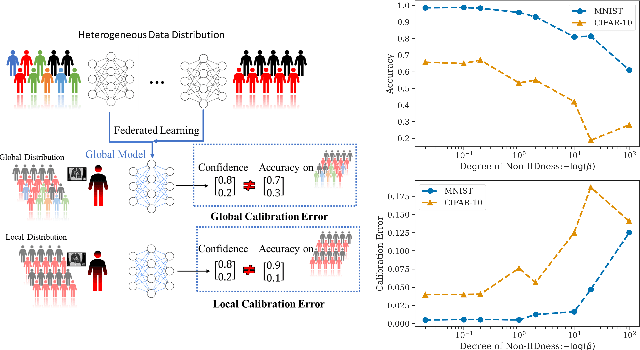

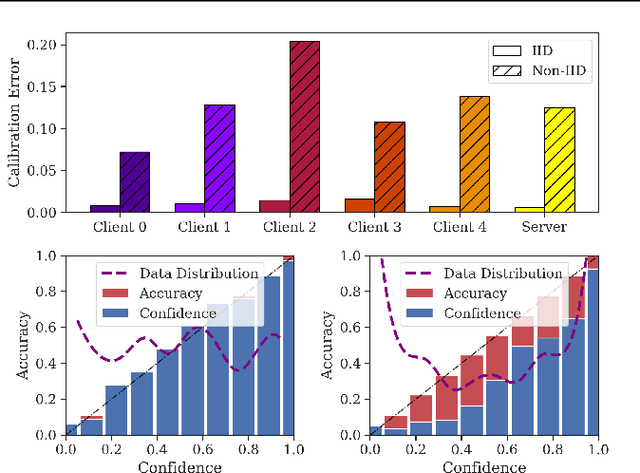
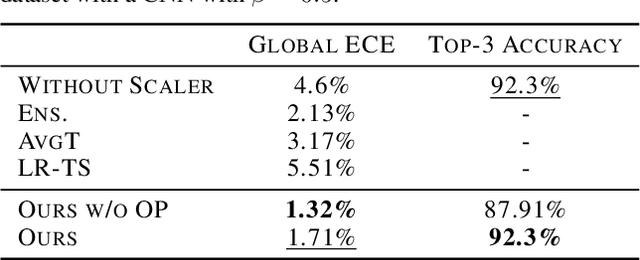
Federated learning (FL) enables collaborative machine learning across distributed data owners, but data heterogeneity poses a challenge for model calibration. While prior work focused on improving accuracy for non-iid data, calibration remains under-explored. This study reveals existing FL aggregation approaches lead to sub-optimal calibration, and theoretical analysis shows despite constraining variance in clients' label distributions, global calibration error is still asymptotically lower bounded. To address this, we propose a novel Federated Calibration (FedCal) approach, emphasizing both local and global calibration. It leverages client-specific scalers for local calibration to effectively correct output misalignment without sacrificing prediction accuracy. These scalers are then aggregated via weight averaging to generate a global scaler, minimizing the global calibration error. Extensive experiments demonstrate FedCal significantly outperforms the best-performing baseline, reducing global calibration error by 47.66% on average.
Advances and Open Challenges in Federated Learning with Foundation Models
Apr 29, 2024


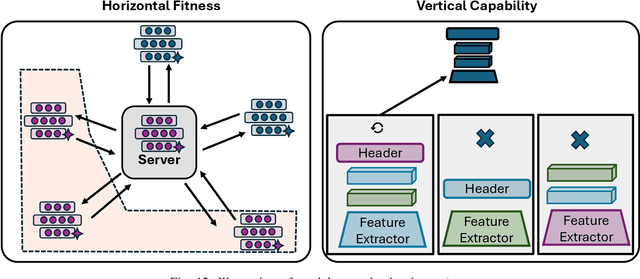
The integration of Foundation Models (FMs) with Federated Learning (FL) presents a transformative paradigm in Artificial Intelligence (AI), offering enhanced capabilities while addressing concerns of privacy, data decentralization, and computational efficiency. This paper provides a comprehensive survey of the emerging field of Federated Foundation Models (FedFM), elucidating their synergistic relationship and exploring novel methodologies, challenges, and future directions that the FL research field needs to focus on in order to thrive in the age of foundation models. A systematic multi-tiered taxonomy is proposed, categorizing existing FedFM approaches for model training, aggregation, trustworthiness, and incentivization. Key challenges, including how to enable FL to deal with high complexity of computational demands, privacy considerations, contribution evaluation, and communication efficiency, are thoroughly discussed. Moreover, the paper explores the intricate challenges of communication, scalability and security inherent in training/fine-tuning FMs via FL, highlighting the potential of quantum computing to revolutionize the training, inference, optimization and data encryption processes. This survey underscores the importance of further research to propel innovation in FedFM, emphasizing the need for developing trustworthy solutions. It serves as a foundational guide for researchers and practitioners interested in contributing to this interdisciplinary and rapidly advancing field.
FedSDG-FS: Efficient and Secure Feature Selection for Vertical Federated Learning
Feb 21, 2023Vertical Federated Learning (VFL) enables multiple data owners, each holding a different subset of features about largely overlapping sets of data sample(s), to jointly train a useful global model. Feature selection (FS) is important to VFL. It is still an open research problem as existing FS works designed for VFL either assumes prior knowledge on the number of noisy features or prior knowledge on the post-training threshold of useful features to be selected, making them unsuitable for practical applications. To bridge this gap, we propose the Federated Stochastic Dual-Gate based Feature Selection (FedSDG-FS) approach. It consists of a Gaussian stochastic dual-gate to efficiently approximate the probability of a feature being selected, with privacy protection through Partially Homomorphic Encryption without a trusted third-party. To reduce overhead, we propose a feature importance initialization method based on Gini impurity, which can accomplish its goals with only two parameter transmissions between the server and the clients. Extensive experiments on both synthetic and real-world datasets show that FedSDG-FS significantly outperforms existing approaches in terms of achieving accurate selection of high-quality features as well as building global models with improved performance.